
Kisum System
Master home document for the Kisum platform. This file is the entry point for the full system documentation.
System Map (Detailed)
Section titled “System Map (Detailed)”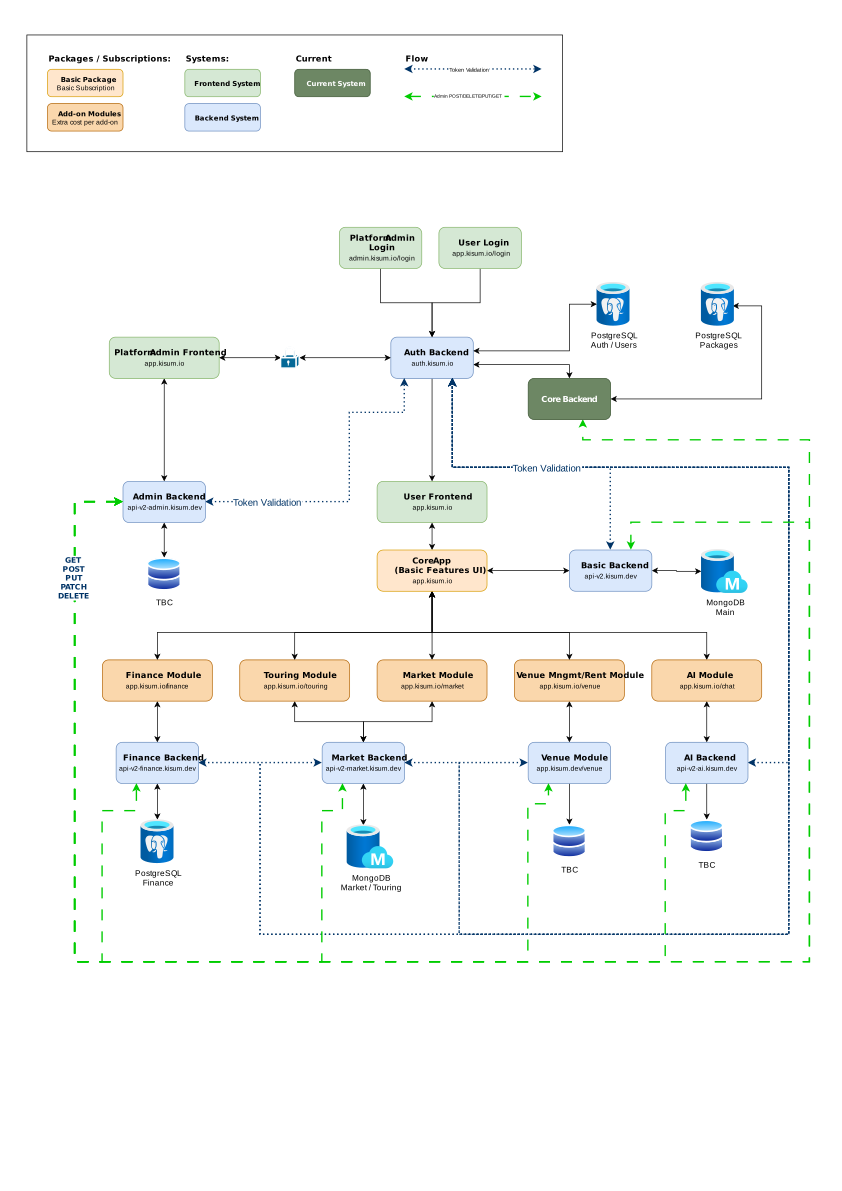 ---
---
1. What this system is
Section titled “1. What this system is”Kisum is a multi-module platform designed to operate as a centralized business system where:
- Auth manages identity, memberships, roles, permissions, delegation, and access computation
- Core manages the commercial model, including packages, add-ons, company entitlements, and subscriptions
- Base manages shared business-domain entities and core platform features
- Modules manage specialized business domains such as Finance, Market, Touring, Venue, and AI
- Frontend consumes resolved access and renders the correct experience, but never becomes the source of truth
- Cross-cutting backend rules define how access, middleware, caching, migration, QA, and error handling must work across the entire system
- AI addon support systems documented in
System-Kisum-Docs, such as the Docker ComposeChat-Kisum-MCP-NodeAI agent plus MCP tooling and the standaloneAI-Event-Intelligence-Copilot-Prototypepromoter copilot service, extend platform capabilities but do not redefine Auth/Core ownership (see Chat + MCP (Node) and AI Event Intelligence Copilot Prototype). - Payments BFF
System-Kisum-Checkout(Next.js,checkout.kisum.io) owns the entire self-serve signup + Xendit payment flow. Auth holds no Xendit credentials or pricing tables; the marketing site (Frontend-Kisum-Website) only collects step 1 and redirects to Checkout for the card iframe. See Checkout (self-serve + Xendit). - Company hard-delete — platform staff purge of a Core tenant via Admin orchestration (tombstone UUID, async
company_delete_jobs, per-service machine purge). See Company hard-delete lifecycle.
This is not a monolithic application with one permission table and one backend doing everything.
This is a layered platform architecture where each domain has a clearly defined responsibility.
2. What this system is for
Section titled “2. What this system is for”The purpose of this system is to provide one coherent platform where:
- companies can subscribe to products and add-ons
- users can belong to one or more companies
- each company can own different module combinations
- each user can be granted different module access inside a company
- each user can also receive fine-grained permissions inside those modules
- higher-level tenant roles can manage lower-level users through controlled delegation
- each module backend can evolve independently while still following the same access model
This architecture is designed to support:
- scalability
- modular product growth
- strong access control
- clean separation between commercial logic and user access logic
- safe future migration away from legacy systems
- clear responsibility boundaries for development teams
3. Core system idea
Section titled “3. Core system idea”The platform follows this central rule:
Company ownership and user access are not the same thing.A company may own:
- Promoter
- Finance
- Artist
- Touring
- Venue
- AI
But users inside that company may still have different access.
So the real access model is:
effective_access = company_entitlements ∩ membership_grantsWhere:
- company_entitlements come from Core
- membership_grants come from Auth
- effective access is computed by Auth
- backend services enforce the result
- frontend only consumes the result for UX
This separation is the foundation of the system.
4. High-level architecture
Section titled “4. High-level architecture”The system is built around these layers:
4.1 Auth layer
Section titled “4.1 Auth layer”Auth is the identity and access brain.
It is responsible for:
- login
- JWT/session lifecycle
- memberships
- tenant roles
- module grants
- permissions
- delegation rules
- invitations
- effective access computation
4.2 Core layer
Section titled “4.2 Core layer”Core is the commercial brain.
It is responsible for:
- package catalog
- add-on catalog
- module catalog
- subscriptions
- company entitlements
- enabled modules per company
Core defines what the company owns.
It does not define what a specific user can use.
4.3 Base layer
Section titled “4.3 Base layer”Base is the shared business backend.
It contains common platform business entities and core business features.
It relies on Auth for access enforcement and must not become a duplicate access system.
4.4 Module layers
Section titled “4.4 Module layers”Modules are independent backend services for specific business domains.
Initial modules include:
- Finance
- Artist
- Touring
- Venue
- AI
Each module owns its own business logic and business data.
Modules are not allowed to compute their own access truth.
4.5 Frontend layer
Section titled “4.5 Frontend layer”Frontend is the UX layer.
It handles:
- login screens
- app shell
- company switching
- module visibility
- route visibility
- action visibility
Frontend does not:
- compute effective access
- decide entitlements
- replace backend enforcement
4.6 Cross-cutting system layer
Section titled “4.6 Cross-cutting system layer”These rules apply to everything:
- access integration
- access matrix
- middleware behavior
- Redis access caching
- admin control plane
- migration from legacy systems
- QA expectations
- error contract
This layer keeps the entire platform consistent.
5. How the system works
Section titled “5. How the system works”5.1 Login flow
Section titled “5.1 Login flow”- user logs in through Auth
- Auth validates credentials
- Auth creates session and returns JWT/refresh token
- frontend calls
/auth/me - frontend determines memberships / active company
- frontend calls
/auth/me/access - Auth loads:
- membership data
- grants
- permissions
- delegation
- company entitlements from Core
- Auth computes effective access
- frontend renders the correct UI
- module/backend requests are later enforced again server-side
5.2 Company context
Section titled “5.2 Company context”The system is tenant-aware.
For tenant-scoped requests, frontend and backends use:
x-org: <companyId>This identifies the active company context.
Without company context, tenant routes must not proceed.
5.3 Access enforcement
Section titled “5.3 Access enforcement”Backend enforcement follows this order:
- validate JWT
- validate
x-org - resolve effective access from Auth
- check module
- check permission
- execute or deny
This means:
- Core does not decide user access
- modules do not compute access
- frontend is not trusted
- access is enforced consistently everywhere
5.4 Module visibility vs backend truth
Section titled “5.4 Module visibility vs backend truth”Frontend may hide modules and buttons based on access context, but backend still remains the final authority.
This means:
- UI can improve UX
- UI cannot replace security
6. What we want from this system
Section titled “6. What we want from this system”The expected outcome of this architecture is:
6.1 Clear separation of concerns
Section titled “6.1 Clear separation of concerns”No duplicated access logic across services.
6.2 Modular growth
Section titled “6.2 Modular growth”New modules can be added without redesigning the whole platform.
6.3 Strong tenant isolation
Section titled “6.3 Strong tenant isolation”Users only operate within valid company context.
6.4 Safe commercial model
Section titled “6.4 Safe commercial model”Company subscriptions and add-ons are owned by Core, not scattered around business services.
6.5 Strong user access model
Section titled “6.5 Strong user access model”User access is centrally computed by Auth, not guessed by each backend.
6.6 Consistent developer experience
Section titled “6.6 Consistent developer experience”Every service follows the same enforcement, error, caching, and integration rules.
6.7 Safe migration
Section titled “6.7 Safe migration”Legacy systems can be moved into the new model in phases without chaos.
7. Documentation map / index
Section titled “7. Documentation map / index”This section is the master index of the backend and frontend documentation.
7.1 Auth
Section titled “7.1 Auth”Defines:
- identity
- memberships
- roles
- permissions
- delegation
- invitations
- effective access computation
7.2 Core
Section titled “7.2 Core”Defines:
- package model
- module catalog
- add-on model
- entitlement model
- internal APIs and Core boundaries
7.3 Module backends
Section titled “7.3 Module backends”- Backend Modules
- Base Modules Backend
- Addon Modules Backend
- Promoters Module Backend
- Venue Module Backend
- Finance Module Backend
- Artist Module Backend
Defines:
- module backend domain
- module boundaries
- data ownership
- integration patterns
- module-specific rules
7.4 Promoters
Section titled “7.4 Promoters”Defines:
- shared business backend architecture
- API surface
- integration role in the full system
7.5 Cross-cutting backend rules
Section titled “7.5 Cross-cutting backend rules”- Access Control Integration
- Access Matrix
- Middleware Implementation
- Access Caching Strategy
- Admin Platform Spec
- Migration Plan Mongo to Auth Core
- QA Test Scenarios
- Error Contract
Defines:
- access rules
- access matrix
- middleware patterns
- cache and invalidation
- admin control plane
- migration strategy
- QA scenarios
- system-wide error contract
7.6 Frontend
Section titled “7.6 Frontend”Defines:
- frontend behavior
- login/bootstrap flow
/auth/meand/auth/me/access- company switching
- route and module visibility
- implementation tasks and sequencing
7.7 Architecture and diagrams
Section titled “7.7 Architecture and diagrams”- Architecture documentation
- Architecture diagrams
- Architecture Permissions
- Architecture Permissions Packages
- Architecture Blueprint
Defines:
- visual system model
- access engine logic
- commercial model
- blueprint flows
- high-level architecture understanding
8. Recommended reading order
Section titled “8. Recommended reading order”For a new engineer or architect, the best reading order is:
8.1 To understand the system first
Section titled “8.1 To understand the system first”8.2 To understand access and commercial model
Section titled “8.2 To understand access and commercial model”8.3 To understand implementation rules
Section titled “8.3 To understand implementation rules”8.4 To understand application and UI behavior
Section titled “8.4 To understand application and UI behavior”8.5 To understand rollout and safety
Section titled “8.5 To understand rollout and safety”9. Setup and implementation expectations
Section titled “9. Setup and implementation expectations”9.1 Development expectation
Section titled “9.1 Development expectation”Teams must not implement features by guessing.
They must use the corresponding documentation layer:
- architecture docs for system intent
- backend docs for service behavior
- cross-cutting docs for consistency
- frontend docs for UI behavior
9.2 Service expectation
Section titled “9.2 Service expectation”Every backend must follow:
- Auth for identity/access truth
- Core for company entitlement truth
- middleware for enforcement
- unified error contract
- unified cache strategy
9.3 Frontend expectation
Section titled “9.3 Frontend expectation”Frontend must:
- use
/auth/me - use
/auth/me/access - use
x-org - reload access after company change
- never decide final security
9.4 Admin expectation
Section titled “9.4 Admin expectation”Platform Admin is the control plane.
It is the only place allowed to write:
- packages
- add-ons
- subscriptions
- entitlement-affecting state
- delegation control rules
9.5 Migration expectation
Section titled “9.5 Migration expectation”Legacy systems must be phased into:
- Auth
- Core
- unified access model
No long-term dual source of truth is acceptable.
10. Build philosophy
Section titled “10. Build philosophy”This system is intentionally designed to avoid the classic problems of a growing product:
- business backends carrying their own access logic
- package logic mixed with user logic
- frontend guessing entitlements
- legacy IDs and legacy access models blocking scale
- module sprawl without domain boundaries
Instead, Kisum is designed as a platform where:
- access is centralized
- commercial logic is centralized
- business services are modular
- integration rules are explicit
- migration is planned
- QA is built into the architecture
- error behavior is standardized
11. Final system principles
Section titled “11. Final system principles”Principle 1
Section titled “Principle 1”Auth decides who can use something.Principle 2
Section titled “Principle 2”Core decides what the company owns.Principle 3
Section titled “Principle 3”Backends enforce, not invent.Principle 4
Section titled “Principle 4”Frontend renders, not authorizes.Principle 5
Section titled “Principle 5”Stale access is a security issue.Principle 6
Section titled “Principle 6”Every service must fail closed.12. Final one-line summary
Section titled “12. Final one-line summary”Kisum is a modular, entitlement-driven, access-controlled platform where Core defines company ownership, Auth computes user access, backends enforce it, and frontend renders the correct experience without becoming the source of truth.